Cool World: Domain Adaptation of Virtual and Real Worlds for Human Detection using Active Learning
2011·,,,
David Vázquez
Antonio López
Daniel Ponsa
Javier Marin
Abstract
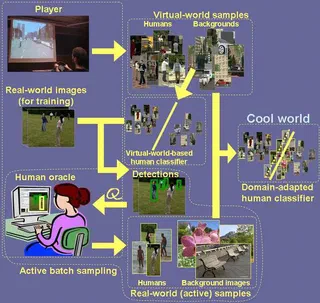
Image based human detection is of great interest due to its potential applications. However, even detecting non-occluded standing humans remains challenging. The most relevant baseline human detector relies on a holistic human classifier that uses histograms of oriented gradients (HOG) as features, and linear support vector machines (Lin-SVM) as learning method. In order to automatize and control the labelling process, we proposed the use of a realistic videogame, i.e., to capture labelled samples of pedestrians and background by playing. The challenge then is to see if the appearance of the virtual pedestrians and background is sufficiently realistic to lead to a pedestrian model that can be successfully applied in real images. We cast the problem as one of supervised domain adaptation, assuming that a small amount of manually labelled samples from real-world images is required. To collect these labelled samples we use an active learning technique. Thus, ultimately the human model is learnt by the combination of virtual- and real-world labelled samples. This combined space is termed cool world.
Type
Publication
Workshop at Advances in Neural Information Processing Systems (NeurIPS)